
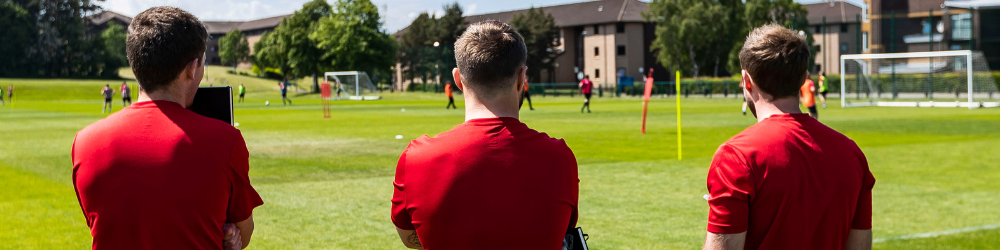
THE COACH
Working predominantly as the head coach of top amateur teams or in some cases as a member of the coaching staff at the professional level
Working closely with coaching staff and support staff
Being involved in developing and applying a club’s technical policy
Ensuring the right balance between the players’ football, professional and private lives
Working with players from different cultural backgrounds, of different ages and experience
Dealing with all other factors affecting the team’s performance: media, parents, players’ agents, fans, scouts, sports ethics
Being accountable to the club’s management: president, technical director, club board, etc
THE PLAYER & TEAM
Planning, executing and supporting individual player development, including their own objectives, and complying with the club’s technical policy
Involving the players in the learning process and enabling them to take responsibility for themselves
Working on the team’s development in cooperation with all support staff, i.e. technical, medical and performance staff
Managing all aspects of the team’s performance
Creating a winning mentality and a performance culture in a positive environment
TRAINING ENVIRONMENT
Preparing and conducting individual and team training sessions at top amateur level
Working with individual players and the team and understanding how the training session design can affect performance
Designing the game-oriented training sessions in terms of opponents, pressure and intensity
Planning, delivering and reviewing training sessions in accordance with the club’s coaching philosophy
Embracing and adopting an interdisciplinary approach to physical preparation and development, wherever possible in cooperation with other members of the multidisciplinary team, e.g. performance analysts, fitness/sports scientists, medical and other performance staff
THE MATCH
Preparing a team for and coaching them during top amateur level matches
Using the game to develop each player and the team, but also to create a winning team mentality
Preparing the match plan in accordance with the club’s playing philosophy, taking the opponent team into account
Analysing the matches as an evaluation and learning tool for individual players and the team as a whole
The UEFA A Licence will build on the competencies gained by the coach through the completion of the UEFA B Licence.
Entrance to the UEFA A Licence course will therefore require completion of the following:
Children’s Wellbeing in Scottish Football (e-learning)
Mental Health in Scottish Football (e-learning)
UEFA B Licence
Notes:
No other qualifications will be accepted as a prerequisite for the UEFA A Licence course. Every successful applicant will:
Hold a valid UEFA B Licence
Have completed at least one year’s experience, after graduating with the UEFA B licence, as a coach in 11-a-side football
Have completed the Scottish FA e-learning courses listed above
All applicants must be working at the highest level of the game possible; working at elite youth and/ or top amateur level as an absolute minimum. To properly implement learning from the course, working with elite youth players at U16 as a minimum is recommended. UEFA A Licence coaching practice, assignments and assessments will be based on the 11 v 11 game
In addition to the above, candidates whose UEFA B Licence was achieved through another National Association must include the following documents:
Evidence of valid UEFA B Licence certification (as well as evidence of appropriate CPD accreditation, if applicable)
Coaching & Playing / Football CV
Letter of support (normally from the club/ team that will be worked with for the duration of the course)
Letter outlining why you wish to undertake the UEFA B Licence with the Scottish FA
UEFA Cross Border forms will only be required if your application has been successful. This will be requested separately
In all of the cases outlined above it is expected that prior to application, each applicant has a Scottish FA Live account and has successfully completed both the Children’s Wellbeing in Scottish Football (e-learning) and Mental Health in Scottish Football (e-learning) courses within the past three years.
Phase 1 - Online Theoretical Modules - Virtual Classrooms
5 day’s duration when the main theoretical components of the course will be delivered
At least 3 course tutorials (comprising of approx. 3 hours in duration each)
SELF-DIRECTED LEARNING: ASSIGNMENT SUBMISSION
Tasks and Assignments to be completed as part of the course curriculum
Some of these assignments will include the need for you to video record your own sessions at your own club. Applicants should therefore ensure that they have the wherewithal at their club to submit recorded sessions
Phase 2 - In Person Coaching Practice
2 separate blocks of 4 day’s duration to participate in teaching and coaching practice. All course participants must be available to attend all scheduled dates.
On successful completion of Phase 1 and Phase 2, course candidates will have undertaken the following:
At least 10 days of online learning
8 days of in-person coaching practice
At least 10 – 12 days for the completion of additional tasks and assignments
After successful completion of Phase 1 and Phase 2, candidates can progress to Phase 3.
Phase 3 - Practical Assessment
To heighten the application of reality based learning and implementation, each course candidate will be expected to submit two full training sessions for assessment.
Successful candidates must ensure that video submissions are of an appropriate standard. Candidates will be provided with filming guidelines that will highlight best practice and provide further information on how to capture footage that is of the required standard, as well as how to record audio.