

The Scottish FA was saddened by the news of the passing of our former President, Rod Petrie.
Our thoughts are with his family and friends at this difficult time.
We asked Hugh MacDonald to pay tribute to a dedicated servant to the Scottish game.
It may just be possible to divine the spot where history and fate came together for Rod Petrie. His capacious, influential and significant life, of course, cannot be captured by a moment.
But Iona Street can be seen as an opening to investigate a life that had humble roots but would have a dramatic impact on so many in his role as president of the Scottish Football Association and as a saviour of Hibernian FC .
Rod had set himself up in the flat in Leith after graduating from Aberdeen University in accountancy and then moving to Edinburgh to begin his career in business. He was following in the footsteps of his father who had also moved south to Iona Street some decades before to work as a labourer in the city.
Rod was in the first generation of the family to go on to university but never lost the values that working on a livestock farm outside Aberdeen had imbued in him. He was from a long line of crofters and his routine was to do chores before and after attending school at Portlethen primary and Mackie Academy.
Iona Street also held a portent for the young accountant. If he was aware of his father’s connection with the street, he could not possibly know that the football stadium down the road would consume much of his working life. Easter Road, in its present incarnation, owes much to the irrepressible spirit of Rod. The training ground in Ormiston also stands as a testament to the power of the extraordinary collaboration between Sir Tom Farmer, the Kwik Fit owner, and Rod.
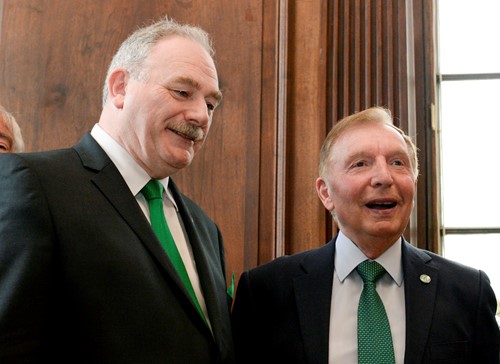
Sir Tom's decision to save Hibernian in 1996 owed nothing to business imperatives. A son of Leith, Sir Tom appreciated the importance of the club to the community. He set about saving it when it was in the throes of severe financial peril. It was then he met Rod who was conducting due diligence on the purchase in a professional capacity.
Sir Tom subsequently pulled the club from receivership and invested with a benign generosity. He almost immediately enlisted Rod as a director before he became managing director then chairman in 2004. Rod was thus enrolled in the world of football. He learned his lessons quickly.
Sir Tom was not a football fan. His involvement was philanthropic but Rod had played at school, captaining both the rugby and football sides at Mackie Academy, and playing at Aberdeen University.
If his professional life first gently tugged him away from the game, his involvement with Sir Tom welded it to him for the rest of his life. His commitment was total. He did not only set standards off the field but also immersed himself in the football side of the business, regularly watching replays of matches. His appetite for knowledge was insatiable.
Rod witnessed triumph and despair at Easter Road. He knew the pain of relegation but he also was there on that greatest of Hibs days when the Scottish Cup was won at Hampden in 2016 after that 114-year blip from winning it last in 1902.
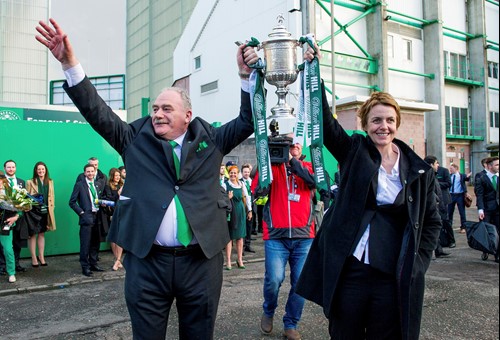
Rod was clearly emotional on that day, showing a side that was rarely presented to the media. However, Leeann Dempster, chief executive at Hibernian from 2014 to 2020, had cause to extol the personal attributes of her boss.
"He was a details man, on top of every part of the business," she said. "His knowledge of institutional matters was formidable and acknowledged across the world. But he was sensitive, compassionate and generous. I am grateful for this, of course, but so are so many at Easter Road and beyond.
"He was very good with young players. He was supportive. Many will have cause to thank him for what he did for them.
"The greatest business lesson he taught me was that the club was the priority. A colleague and myself were having issues with an agent who was messing us about. We were ready to walk away from the deal. But Rod told me: 'hold your nose, forget personal feelings, and do the best for the club'. The deal went through and the player was an asset to Hibs."
She added: "He was the best negotiator, too, and a font of knowledge, but my best memories of him involved the journey by car to games. I think people who didn't really know him could misread him. He was funny and generous."
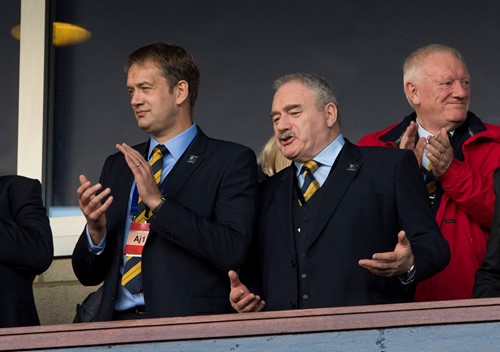
His experience and personality were also lauded by Ian Maxwell, chief executive of the Scottish FA. Rod was president of the body from 2019 to 2023 when he oversaw the purchase of Hampden and guided Scottish football through the unprecedented turmoil of Covid.
He had served on various committees for more than two decades and his contribution to the national game was immense. He worked on, even after his diagnosis with cancer.
"He had a big brain, a determined manner and was hugely experienced," said Ian. "He was respected all over the world and he had an immense range of contacts. He was always concerned about good governance, doing the right thing. His service for club and country is immeasurable."
He also pointed out that Rod could be humorous but also could be unwittingly funny. "He was always very punctual so we were all surprised when he arrived slightly late at a meeting. He apologised before saying: 'I just got lost in a spreadsheet'. Rod was the only man I know who could find a spreadsheet so enthralling."
He added: "He is a great loss to the national game and, of course, to his family and wide circle of close friends."
Rod inspired trust in others. Executives, players and fans could confide their concerns to him and he was always willing to spare time and give counsel. Trust, integrity and a commitment to work to fulfil aims were the constants for Rod.
This and so much more informed a life of outstanding professional achievement and private fulfilment.
Hibernian has survived for 150 years and that achievement has been duly celebrated. It is in debt to the accountant who became a indefatigable supporter. It is one shared, too, by Scottish football.
Rod, who is survived by his partner, Morag, his two sons, and four grandchildren, arrived almost anonymously in Iona Street. He was following in the footsteps of his father but he made his own path in life. It led down the street to Easter Road and on to the world.