

Everyone involved with the Scottish FA was saddened by the passing of our former Director of Coaching, Jim Fleeting, who made such a profound impact on the Scottish game across a distinguished career.
We asked close friend and journalist Gordon Waddell to pay tribute to someone who leaves a lasting legacy, from grassroots through to the elite levels of the game.
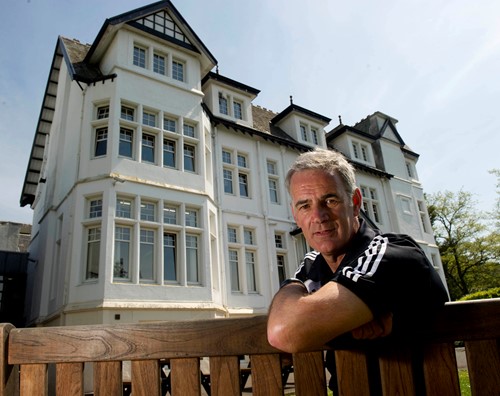
"Ach, I'm just a toolmaker fae Ayrshire."
The deflector shield of honest humility put up every time anyone tried to give him credit for anything.
But the truth is, from the grassroots of football in this country up, through every community club and every kid with a ball at their feet to every coach who passed a badge over the past three decades, there's a little bit of Big J's DNA in every one of them.
The colossal work he did for the game may have flown under the radar in terms of back-page headlines - but it should never be under-appreciated.
And it never will be by anyone who either worked for him, with him or spent any time under his tutelage in any of the myriad roles he fulfilled in a quarter of a century in the Scottish FA technical department.
His passion was unmatched and undiluted. For football, sure - he loved the game, had done all his life - but more for its people.
Fleets was a proper leader. Being a great guy came as naturally to him as breathing, but leadership is about more than just getting people to like you. It's about creating an environment and a culture to improve the world around you and Jim put a lifetime's worth of work into making that true, for his staff and for the game as a whole.
His team will all tell you he was the best boss, because he empowered all of them. There wasn't one who wouldn’t have run through a brick wall for him if he asked - even if the ask came in one of his frequent 7am phone calls on his way into Hampden!
We've already seen heartfelt tributes and obituaries from so many clubs which document Jim’s life and times, his career as a player, a manager, a coach, a mentor and why he was treasured both sides of his native Ayrshire's divide as United’s captain and Killie’s manager at the beginning of their journey back to credibility alongside his brother Bobby.
They all mention, rightly, that his mantra was always 'family first' - wife Irene, kids Gemma, Julie and Barry and his nine grandchildren were his everything, with football, friends and community a respectable distance behind in joint second.
But this is more a tribute to make people realise just how much of Jim Fleeting is embedded in our national sport.
It's hard to know where to start, but let's do it from the ground up.
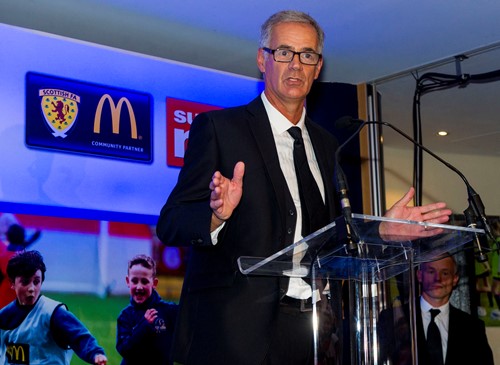
The Grassroots Awards were his brilliant brainchild in 2004 - he saw the commitment it took to keep football alive in every corner of the country and the unsung heroes who provided it, and in typical fashion, wanted them to get some of the credit they deserved but never sought.
His powers of persuasion got a global business giant in McDonald’s as a sponsor, got the Sunday Mail - at the time, the country’s biggest newspaper - as a media partner, and began unearthing some of the greatest success stories in Scottish football to celebrate them in full view.
Nearly a quarter of a century on, it's still going strong, and thousands of men and women who are the life and soul of the sport in villages, towns and cities from Campbeltown to Wick, from Kirkwall to Kirkcudbrightshire, have been recognised.
It didn't stop there, though. Fleets' idea was so good, McDonald's took it and ran with it across England, Wales and Northern Ireland - and once UEFA got wind of its phenomenal appeal, they created their own version and made Jim very much a part of it.
In a world where resources have become ever more skewed towards elite football, he was the grassroots game's biggest advocate.
He knew where football's true beating heart lay and he steered a path to help create a benchmark for community clubs across the country, setting standards for facilities, pitches and people that could be scaled and replicated to make sure kids get what they need to play, irrespective of cost.
He'd seen it on his travels and thought, 'Why can't we have that?'. So he brought clubs like Aalborg across from Denmark to talk through how they'd created their model, provided the lightbulb moment - then said, 'What can WE do to make this happen?'.
He challenged people constantly. Not in a confrontational way, and never without evidence that we COULD be better - simply to change their mindset, to stop 'no' or 'can't' being a default answer.
At one point, he got a bee in his bonnet about the 'physical literacy' of kids in Scotland, with all the statistics showing it had fallen behind that of nations across Scandinavia and western Europe. So he tackled the Scottish government and local education authorities to come up with a programme to make it better, to get kids participating and active, not just in football, but across all sport. Better Movers and Thinkers.
Getting people to work in partnership might sound like it's the easiest thing in the world but Jim turned it into an art form.
And that was just at one end of the game. At the other, he was just as determined to leave an indelibly positive mark.
He inherited a coach education system which was already respected across the world, but never satisfied, he took it to another level.
He took a trip down south to speak to Largs alumni like Davie Moyes and Sir Alex Ferguson, he spoke to longstanding pals like Walter Smith, and said, 'How can we evolve this? How do we get our coaches to another level?', before taking their suggestions on board and incorporating things like learning a second language into their UEFA Pro Licence to broaden the horizons of his candidates.
He also loved having the influence to be able to persuade the titans of the coaching world to come to Scotland, not as a badge of honour for himself, but for the treasure trove of experience they offered to those under his stewardship when they were doing their CPD.
He was like a kid in a sweetie shop, telling you he was picking up Carlos Alberto Parreira, or Marcello Lippi, or Lars Lagerback, from the airport, dying to listen to what they had to offer to a fresh generation of Scottish managers.

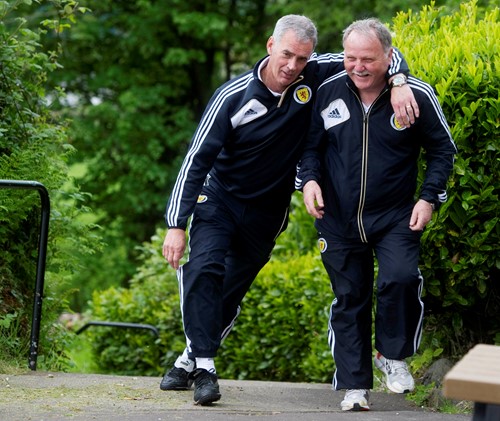
He still loved the feel of the grass under his studs, though. You'd never find him happier than on the field at Largs or later Oriam, with great pals like Donald Park, Jimmy Bone, Dick Campbell and myriad others by his side, putting people through their paces, or playing with the over-35s at his beloved Kilwinning Sports Club into his 60s.
He kept his skills sharp with stints as Billy Stark's assistant at the Under-21s and with the women's national team. Speak to any of the younger players who experienced him in a squad environment and they'll all say the same thing. He didn't teach them football, he taught them values.
There was nothing false about J's modesty, either. It was his default setting. He hated talking about himself, preferring instead to put others front and centre.
We knew each other professionally for 25 years and I could count on one hand the number of times I was allowed to quote him.
One occasion, to me, typified him.
We're in the middle of an interview, which he has given, grudgingly, to discuss the 40th anniversary of the North American Soccer League, which he had graced as a young player.
"Haud on…I think they're in the loft."
And off he disappears. Again grudgingly. He can't think for the life of him why anyone would be remotely interested.
Five minutes later he appears with an ancient, crumpled supermarket poly bag.
Empties the contents on the sofa.
Two New York Cosmos shirts. One with 'Beckenbauer' on the back, the other with 'Carlos Alberto'. Never washed, never framed, never shown off.
Mementos from a season with the Tampa Bay Rowdies which finished with him, just a lanky kid from Ayrshire, on loan from Norwich to open his eyes to the world, playing against these two World Cup-winning behemoths of the global game in 'Soccer Bowl', the NASL’s grand final, in front of 74,901 at Giants Stadium.
My eyes pop out of my head. He shrugs.
"Ach, they're just shirts, big fella - they don't MEAN anything."
That summed Jim up to perfection.
His own success was never a benchmark for him. Everyone else's was.
It's what made him such a good coach educator.
He recognised opportunities when he saw them too. Every summer, he’d spend weeks at Largs taking the 'A' and 'B' introductory and advanced Licence candidates through the programme, embracing all-comers from around the globe, and mixing seasoned pros looking to take their next step in management with dedicated amateurs simply looking to raise the standards at their local clubs.
He'd happily accommodate one or two journos to interview the pros at an otherwise fallow time for football in mid June and July, with two caveats.
One was that we had to mention the course and its success stories, and get a photographer to take a team picture. Easy done, the players loved it, loved him.
Two was that there was an admission price to be paid.
Cakes. And not just any cakes - don't dare ever walk in with a box that said Tesco or Asda or Greggs.
Local bakers only. Proper bakers. And if you knew what was good for you, Irvine's the Bakers from Kilbirnie.
I once turned up with a banana loaf fresh out of the Waddell oven, baked that morning by my wife, thinking it was the ultimate offering.
Wee Parky's eyes lit up. Same as everyone else round the table.
Except big J. "Call that a cake?", he says. "THAT'S no' a cake." The lack of cream, by all accounts, was its downfall. The big man took his bakery items deadly seriously!
Another time I'd called to ask who was on his 'A' Licence, if there were any interviews worth coming down for.
"Duncan Ferguson," he says.
A virtual recluse for five years since hanging up his boots and moving to Mallorca, the big man hadn't done an interview in 20 years with a member of the Scottish press, nursing a grudge since he'd ended up in Barlinnie.
"I'll get him to talk to you," says J.
"No chance."
"I'll bet you a Mars Bar."
“I’ll bet you my mortgage.”
The following morning, I woke up to a text that said simply, "Bring a Mars Bar…"
And there, in the glorious Ayrshire sunshine, I stood for the thick end of half an hour with a guy who at my last attempt to speak to him a decade previously after his FA Cup win for Everton at Wembley, had delivered a two-word custard pie to my face.
But who, like anyone who ever met him, would have done anything Jim asked of him.
Same as I would.
I was lucky enough to host the aforementioned Grassroots Awards with Fleets for more than 15 years at Hampden - the only downside was following him on stage after his introductory remarks - always backdropped by pictures of his grandkids - had the entire audience in the palm of his hand with his usual blend of passion, humour and honest-to-goodness gratitude for what all 500 people in the room had done for the game that year.

The silver fox was unbeatable. Kenny Dalglish was McDonald’s brand ambassador, but even with his God-like status, he and I would roll our eyes knowing whatever we said next would fall short.
King Kenny's Hampden was out on the pitch. Inside belonged to Jim.
Up on the sixth floor, there's an office that played host to 25 years’ worth of crack-of-dawn mornings and late nights thinking of ways to get us to the World Cup from the grassroots up.
Jim leaves us having lived a life worth living and worth celebrating, despite knowing he'd tell us not to make a fuss.
He was a force for good and a force of nature from whom we inherit a legacy that lives on in every community and in every coach, in every facility and every programme.
And for that, the entire game should be grateful.
Not bad for 'just a toolmaker from Ayrshire'.
Rest easy, Jim. You've earned it.