

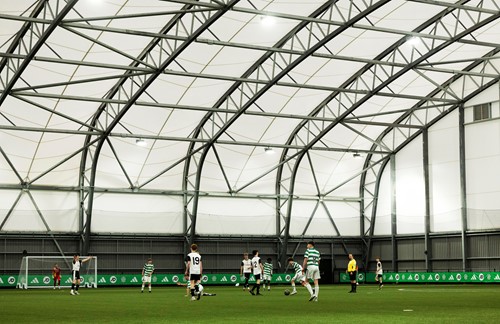
The biggest bio-banding festival ever seen in youth football took place across Scotland at the end of last month, with 12 teams competing across three locations.
Celtic, Rangers and Hearts hosted the Club Academy Scotland (CAS) events, with Aberdeen, Ayr United, Dundee, Dundee United, Falkirk, Hibernian, Kilmarnock, Motherwell and St Mirren involved.
Bio-banding is a concept which sees players periodically grouped by their biological age rather than their chronological age, with the aim of providing more developmentally appropriate challenges for both late and early-maturing players.
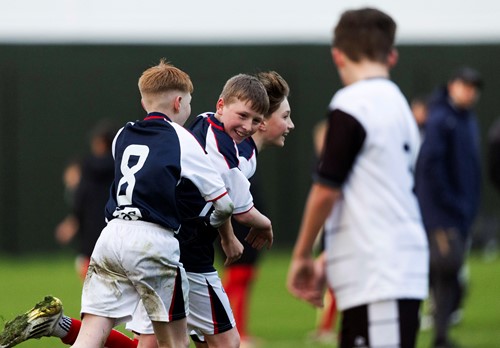
Late maturers, who can struggle against players their own age, can benefit by playing against younger players that are a closer physical match, and take on positions of leadership, while early maturing players, who typically possess a physical advantage over lesser mature athletes, are tested by playing with older players.
The timing of the event was fitting, in the month that Scott McTominay - a late-developer who was nurtured through the process of growth and maturation by his club - helped inspire Scotland back to our first World Cup in 28 years, with a dramatic 4-2 win over Denmark.
McTominay himself is featured in the foreword of the Scottish FA's bio-banding guide that was presented to clubs earlier this season, aiming to inform and educate on the benefits of the concept.


At each festival, players aged between 10 and 16 were split into three groups, based on percentage of predicted adult heights, with each group playing three nine-a-side matches across the day.
Across the three locations, the average biological ages of groups 1, 2 and 3 were 12.5, 13.4 and 14.2 respectively.
These festivals are set to be a regular occurrence within CAS throughout the season, although they are not a replacement for age group competition - rather they are an additional format that challenge and evaluate players in a different learning context.
Following the events, the players completed a questionnaire, with all groups indicating they would be enthusiastic about more of these events being organised.
The full Scottish FA internal report, completed following the festival, by be found here.

This introduction of these bio-banding festivals also comes after the Scottish FA commissioned the world's biggest growth and maturation study in academy football earlier this year.
The report analysed the impacts of relative age and biological maturation on talent identification and development within the Club Academy Scotland (CAS) system, and found that Scottish football followed the global trend of bias towards early developing players and the players born earlier in the year.
In addition to this increased emphasis on these bio-banding events, the Scottish FA has also introduced a new pilot policy within CAS to give clubs increased flexibility to group certain players by biological rather than chronological age in their regular fixtures as well.
Lack of education in the management of the key growth spurt period was outlined as a key issue in youth development, in the Scottish FA's Transition Report. The importance of a Growth Maturation Strategy, helping both early and late-maturing players to excel, was also highlighted within the report's key recommendations.

David Sheldon, Club Academy Scotland Programme Manager, Scottish FA: "Obviously we don't want this to replace age group football, but at key touch points throughout the year, these events are going to be very beneficial for the academies.
"We want to create a dynamic system where scouts, coaches, academy directors and sport scientists all get a really holistic view of the player.
"Whether it's with training sessions with bio-banded groupings, or whether it's festivals of tournaments, we're looking to give everyone a different perspective on how to analyse how the players are developing.
“The Bio-Banding festivals bring to life our education resource and club workshops, while the impact report giving us fantastic insights from a player perspective so we can ensure that future events planned with CAS Clubs can be improved and be even more impactful”
Steve Curnyn, Sport Scientist, and author of the Scottish Football Association's Growth and Maturation Study: "Usually in football and all sports, the kids are grouped by Under-10s, Under-11s, Under-12s, but for these festivals, we grouped players by percentage of adult height - which is a marker of biological maturity.
"The feedback has been very positive. The clubs have acknowledged that it is a lot of work, it does take a lot of the time but it's worth it for the chance to view and assess players differently.
"Ultimately these events are a tool for us to understand how players cope in different situations. For example, we see a player is suddenly getting more touches of the ball and playing with a smile on their face, or a player is more involved and influencing the play more than they usually have the chance to do.
"It's a real part of our responsibility to help try and nurture that talent to reach its potential, and give every player their chance to succeed."
John Cox, Head of Sport Science, Kilmarnock Academy: "Physically, I think bio-banding is a good tool. We look at early maturing players - so players who are a bit bigger and stronger than their peers. We can group those players into teams, regardless of what their chronologic age is and include players from a number of different age groups.
"When we group them together, we can see how their technical, tactical and physical performance is affected, compared to when they play in their own age groups.
"Does the bio-banding influence some more leadership from some players? Does it influence game understanding and do the players enjoy it a bit more?
"If we've got a lot of less-developed players, we can play them against players from other clubs who are at a similar stage of development and it maybe gives that player a bit more confidence."
David Hartley, Celtic Head of Academy Performance: "It's really interesting how bio-banding can give you a different perspective on players with high potential.
"Every player in our academy is on their own individual project, because everyone grows at different rates, so traditional age groups don't always give you that challenging environments for players.
"By helping players who have long-term potential but who don't have that physicality yet, we can be a bit more patient, and likewise, for those who have developed early its about giving them more of a physical challenge so we can develop their technical skills in a more robust way."